Whiplash Disorders: Why You Should Get Your Fat Neck in Shape

Read Time: <7-8 min>

I know it’s a little bit of a crazy headline, but today we’re going to talk about how a fat neck can contribute to chronic whiplash pain.

But I’m not talking about the width of someone’s neck. The neck I’m talking about can be thin on the surface, but have fat tissue build up in places where it shouldn’t. Namely, inside of your muscles.

It’s helped us to reveal a problem that many doctors miss when looking at conventional MRI findings.

Don’t Put So Much Stock in Disc Problems

For better or for worse, injuries from auto accidents are usually made or broken by MRI findings. That’s why your attorney has likely pushed you to get an MRI even though your doctor may have chosen against it.

If your doctor is like me, they avoid too jumping to MRI’s too quickly because sometimes it can really cause more harm than good. MRI’s give you the most highly detailed images available to the average consumer, but those extra details can be counterproductive.

In a patient’s eyes, an MRI report can be intimidating and scary. It’s common for most MRI reports to say things like:

  1. Disc herniation
  2. Degenerative changes
  3. Stenosis
  4. Loss of disc space
  5. etc

Which is fine if you’re a health care professional and you need to know what’s going on. However, a lot of patients will look at these words, do a quick google search, and end up looking like this:

There’s a couple things to remember when seeing some of your MRI findings:

  1. Many of these findings are seen in normal aging
  2. Just because it’s on an MRI doesn’t mean it’s causing your pain or condition To add more insult to injury (pun intended), things like herniated and degenerated discs are very disempowering as a diagnosis. In most cases, those findings are going to stay with you throughout your life, and that’s okay because even healthy pain-free people will have it throughout their lives too!

….even healthy pain-free people will have have herniated and degenerated discs throughout their lives too!

Whiplash and Fatty Neck Muscles

Generally we all wish we had a little less fat around our waist lines. In recent years, researchers have been seeing that fat can build up in muscular tissue and is associated with problems of aging. You can read some more about the science behind this problem in a great article on the Strength Theory Blog here.  This includes chronic pain which is the major concern for patients with whiplash.

Some recent studies are starting to show that identifying fat build up in your neck muscles can predict how well someone with whiplash will recover.

If you don’t want to read the abstracts, here’s the summary:

Patients with greater fat build up in neck muscles after an accident are more likely to have more persistent whiplash symptoms.

This runs counter to people with herniated discs because the presence of herniations is generally a poor predictor of pain.

  1. Reducing sensitivity of muscle to insulin (Translation: muscle won’t eat as much sugar as it normally does)
  2. Reducing Kreb’s cycle activity of muscle (Translation: muscle won’t use energy as efficiently)
  3. Increasing the release of pro-inflammatory cytokines (Translation: more inflammation around muscle –> More pain) Ultimately, fatty muscle tissue effects how the muscle contracts, how the muscle eats, how the muscle digests, and it predisposes your muscles to pain and inflammation. While the evidence is still pretty new , it does seem to reflect why people who are stronger and have more muscle seem to be more resilient to pain problems.

Unlike Bad Discs, This Problem is Fixable

Fatty muscles can result from prolonged periods of inactivity. So it seems like a pretty simple fix. Move more, exercise, and get stronger. A small study on exercise for women with whiplash disorders show that neck exercise can reduce fat content in neck muscles and improve someone’s prognosis, so it does look like this problem is fixable.

However, one of the things that triggers inactivity after a whiplash accident is the immediate pain itself. When you have a whiplash, even small amounts of movement tend to be painful or instigate symptoms. The thought of exercising just sounds….painful.

So what can you do after an accident? Fortunately, these same rules apply with or without an MRI.

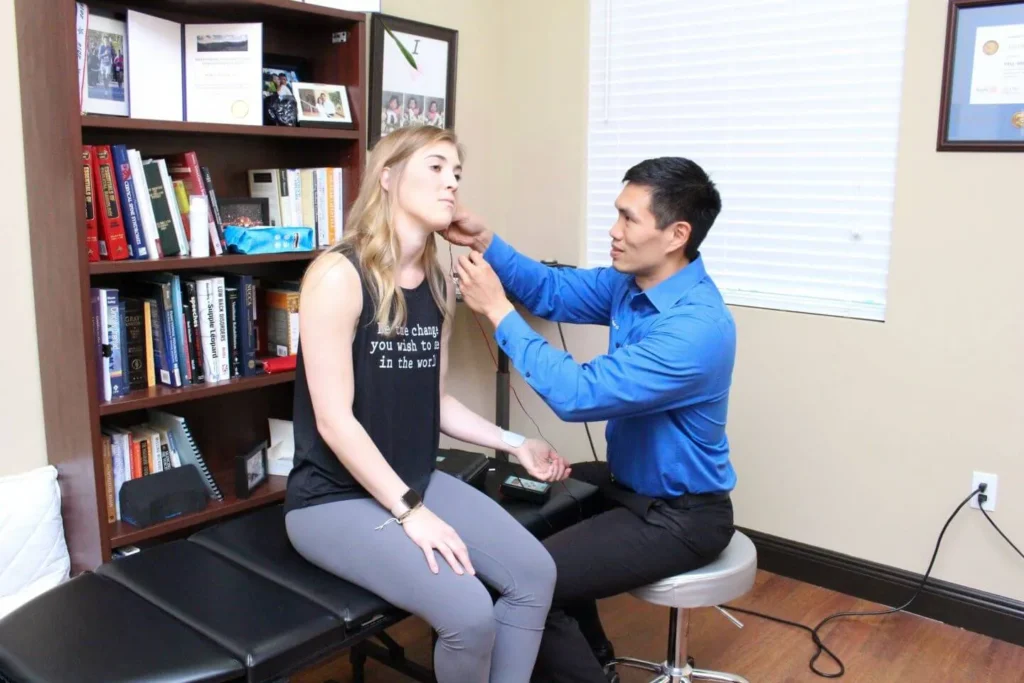
  1. Get the initial pain under control – There’s no shortage of therapies that can help control pain. Some use ice, heat, TENS, acupuncture, spinal manipulation, massage,  meds, etc. In order for you to get your body moving, you have to overcome the fear of movement that pain can cause.
  2. Position Matters – the ability to control the position of the neck is a key piece in normal movement. Developing this control depends heavily on establishing normal structure and normal positioning of the neck. This is where a structural approach to chiropractic plays a major role in recovery.Abnormal loading of the joints in your neck from Atlas Displacement Complex can contribute to pain, but it also can lead to Secondary problems like vertigo, headache, and brain fog after a whiplash.
  3. Gradual Progressive Loading – As the neck feels better and your positioning improves, you will want to gradually increase the strength of the muscles in the neck. Basic neck exercises like the chin tuck and chin nod can help train the small deep muscles of the neck. As the muscles get stronger and more functional, you will protect your muscles from fatty degeneration.Starting slow and gradually building up the resistance and endurance of your neck muscles is a key step in getting a good long term result after a car accident. With a great understanding of the problems associated from chronic whiplash, we can utilize better tools to make sure that you don’t become a victim to chronic pain.

Real Patient Testimonials

Clemence Heller
I can’t say enough how much my life has changed under Dr. Chung’s care. After 10 years of chronic pain and being dismissed by my neurologist, I came to Dr. C. He was caring, and really listened. After only 2 visits, I have already had a tremendous reduction in my pain! I feel like a new person.
Michelle Graham
I can't say how much Dr Jonathan Chung has given me back a full quality of life. Migraines was my daily focus, brought my on by a minor car accident few years before. I thought I was going to live with pain medications for the rest of my life. After seeing 2 neurologist prior I was convinced that was my life. But I never stop searching for holistic approaches which led me to Keystone Chiropractic. Thank you.
Sabrina Kopejz
Dr.Chung has been a huge part of my journey to getting back to how I was before my dizziness and vestibular issues. Under his care I am now better than how I was before and I am able to live a normal life again. He is passionate about his patients and he’s such a great person. I’m so happy he’s my doctor! His staff is amazing as well!

Contact Us

Get Started Today

We’re here to help you take the first step toward better health, with compassion, precision, and a care experience that puts you first.

Phone Number

Business Hours


Keystone Chiropractic & Neuroplasticity

You Have Been Adjusted a Hundred Times. Why Has It Never Held?

FOR PEOPLE WHO HAVE BEEN ADJUSTED A HUNDRED TIMES AND STILL HURT

Relief that lasts four days is not a correction. It is a rental. There is a structural reason your body keeps pulling back to the place that hurts, and until someone measures it, nothing changes.


Keystone Chiropractic & Neuroplasticity

Benefits of Chiropractic Care

Most people are aware of the pain-reducing advantages of this remarkable science. Here are other common benefits and specific conditions that we focus on at Keystone Chiropractic & Neuroplasticity:

  •  

Keystone Chiropractic & Neuroplasticity

If You Are Reading This, You Have Probably Already Tried:

And somewhere in there, you started wondering if this is just your body now.

It is not.

Keystone Chiropractic & Neuroplasticity

The Reason Relief Keeps Expiring

Things that hold have structure.

Every treatment you have tried worked on the symptom. The muscle that was tight. The joint that was stuck. The nerve that was screaming. And each one worked, right up until your body pulled back to the position it was in before you walked in.

Because the position never changed.

You have been treated by good people who never measured your structure, because measuring it takes an instrument almost no one owns and training almost no one has. Not their fault. It just means the actual question never got asked.

You cannot correct what nobody has measured. Everything else is maintenance.

Keystone Chiropractic & Neuroplasticity

Your MRI Was Not Wrong. It Was Answering a Different Question.

An MRI is built to find disease. Tumors. Herniations. Ruptures. The things that need a surgeon.

When yours came back clean, it did its job perfectly. It told you that you do not have the thing it was designed to find.

But it was never built to measure how your head sits on top of your neck. By how many degrees. Or how that position interferes with the nerves running through it.

Different question. Different instruments. Different results.

What an MRI looks for

What we measure

The One Thing Almost No One Measures

Our doctors correct the alignment at the very top of your spine, and we do it with the specific precision required to return your body to the position it needs to be in to heal the way it was designed to.

That is the entire focus. Not a menu of services. One correction, measured and made properly.

Dr. Jonathan Chung

Keystone Chiropractic & Neuroplasticity

Where This Actually Starts

It is called The Comprehensive. Sixty minutes, one on one with one of our doctors, and it runs in three parts.

01. We Listen

You talk. We listen. Your whole history, everything you have tried, what it has cost you, and what you have given up because of it. Not a five minute intake. An actual conversation about your specific problem.

02. We Learn

Then we measure what nobody has measured.

What is working. What is not. And why.

03. We Lead

You leave knowing the root cause, why this has never held, and exactly what correcting it would take. In plain language, with your own numbers in front of you.

Sixty minutes to finally get the answer that years of appointments never gave you.

This is what The Comprehensive actually looks like: a full structural exam, not a quick adjustment.

Keystone Chiropractic & Neuroplasticity

If We Cannot Correct It, We Will Tell You On Day One

Here is our promise.

If our doctors do not find a structural cause that we can correct, they will tell you on day one, and we will not take you on as a patient.

No treatment plan. No package. No follow up call three days later.

You leave with the truth and a direction. Not a sales pitch.

We would rather lose the patient than sell you another rental.

What It Costs To Find Out

Continue to imaging? The $ is credited toward your care. Come in and decide not to move forward? We refund the $. Either way? The Spine Strong Library is yours the moment you book. Free When You Book: The Spine Strong Library Our complete exercise system. The full library, yours to keep whether or not you ever become a patient. We send it the moment you reserve your time.

People Who Stopped Renting Relief

Bonnie M.
Miami, FL · 20 years of low back pain
"After the first adjustment, my pain was gone! I am so happy! I can't say enough, I feel like a new person!"
Barbara P.
Parkland, FL · Chronic neck pain & TMJ
"I had no neck pain within weeks of treatment, no tension, and my TMJ is minimal."
Christy
Coral Springs, FL · Degenerative disc disease
"After experiencing a NUCCA adjustment, I no longer had back pain. I urge others to try NUCCA prior to any surgery!"
Erin D.
Coral Springs, FL · Chronic migraines & headaches
"I am virtually migraine and headache free... I have my life back!!!"

Keystone Chiropractic & Neuroplasticity

What It Costs To Find Out

Before You Book

Is this just a chiropractor?

Our doctors correct one specific thing: the alignment at the top of your spine. That is a narrower and more measured discipline than general adjusting, and it starts with instruments rather than hands. If you have been adjusted before and it did not hold, this is the reason we start with a measurement instead of a table.

Because sixty minutes of a doctor’s time is real, and a free appointment is an appointment people do not show up for. The $45 reserves the slot. If you come in and decide not to move forward, you get it back.

Then we tell you on day one and we do not take you on as a patient. You leave with what we measured and a direction to take it.

That depends entirely on what we find, and anyone who quotes you a timeline before measuring you is guessing. You will get a specific answer at the end of your Comprehensive, based on your own numbers.

Possibly. If your Comprehensive points to a structural cause, imaging is the next step, and your $45 is credited toward it.

Yes. We accept most PPO plans, auto/PIP insurance for accident injuries, and FSA/HSA funds, plus patient financing and direct-pay options if you’re uninsured. Call (954) 645-7272 and we’ll verify your benefits before your first visit.

4500 N University Dr, Suite 100, Coral Springs, FL 33065 — right next to the 7-Eleven at the corner of University Dr & Wiles Rd, with parking out front. Call (954) 645-7272 with questions.

Any prior imaging you have, a list of what you have already tried, and sixty minutes without a hard stop after it.