Is Head Tilt Driving Your Brain Crazy?

Washington Post, and the perils of slouching have been written about ad nauseum.

I won’t get into that today, because I think there’s a problem that is a lot more important but gets far less attention. Most doctors will ignore this, but chances are it’s a major contributor to headache, balance disorders, vision problems, and overall brain health.

Today we’re going to break down your head tilt.

Cute for Puppies and Sorority Poses, Bad for Patients with Neurological Issues

First we should clarify a couple of things. When we discuss head tilt, we’re not talking about the tilt that comes on when you intentionally tilt your head for a photo. If you are intentionally creating a momentary head tilt, it’s not a big deal. There’s no such thing as a bad posture if you are willfully and intentionally trying to create a specific shape with your body in gravity.

We only classify postures as negative when your body is doing something that it is not intending. If I ask you to stand up as straight as you can and your head tilts to side, it paints a much different picture of your brain than if I asked you to purposefully hold your head to the side. An inability for you to create a straight upright posture suggests that you have a deficiency in your brain’s ability to control your muscular system. You can read about that in greater detail here: Why Your Posture Isn’t That Important

So what’s the big deal if your head tilts to the side? It’s a sign that your brain is perceiving the world around it incorrectly.

If your brain is getting wrong information from your senses, then it can’t produce the right response to the world around it.

It doesn’t sound like a big deal when we’re talking about posture, muscles, and bones, but let’s apply the same idea to some of your other senses:

  1. If you have a problem with one of your eyes, how will that affect your ability to catch a baseball?
  2. If your ears are hearing a high pitched noise all of the time when everything is quiet, how will that make you feel?
  3. If your skin is constantly itching, but you have nothing on your skin that is irritating it, will you keep scratching? All of these are examples of your brain perceiving the environment incorrectly and they all lead to specific conditions from a lack of depth perception, tinnitus, to neuropathic itch. When left for a long time, these conditions can have a significant impact on your enjoyment of life.

So what are the consequences of a chronic head tilt?

The Physiology of Head Tilt

How your brain decides to hold the head up involves a lot more neurology than most people expect. Generally speaking, we think about head tilts being a result of tight muscles pulling the head out of place. When we use this model, treatments become a matter of rubbing one muscle and stretch another and the head will be straight again.

For better or worse, the way the brain moves the head is WAY more complex than that. Your brain decides where to put your head in space based on the interplay of your inner ear organ, your eyes, and the small muscles of your neck.  Here’s how it works:

What Happens When Your Head Tilt Breaks?

This is why the biggest problems associated with whiplash and concussion injuries are balance and vision issues. You can’t keep your perception of the world straight if your eyes, ears, and spine are giving you inaccurate information about gravity!

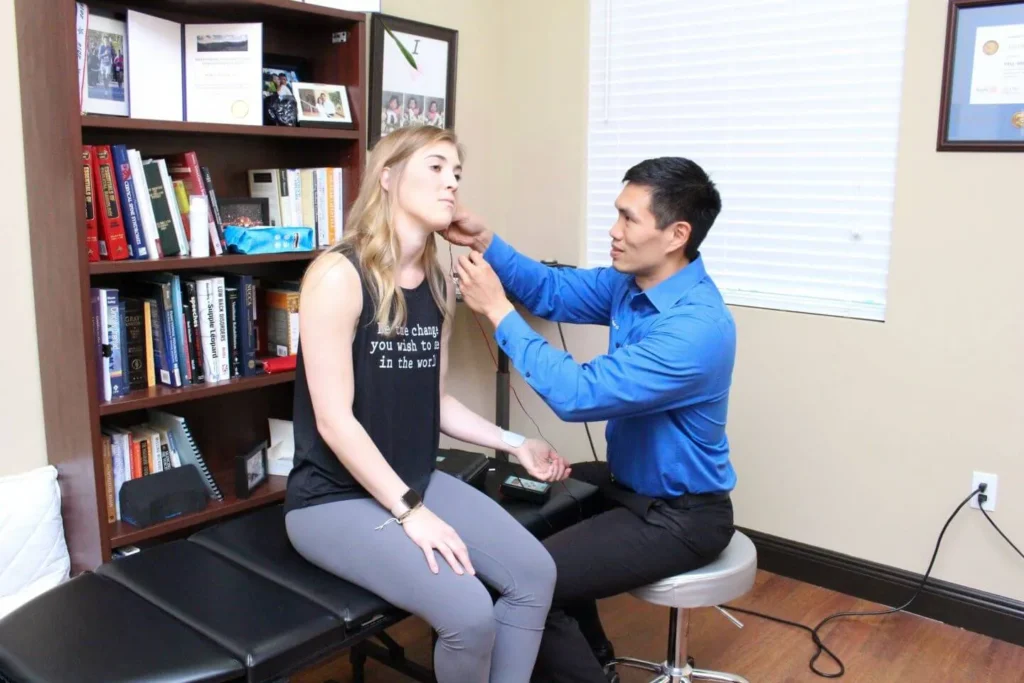
When your head and neck get scrambled by a hit and you disrupt these 3 systems, your body takes on an abnormal head posture which can make the other systems work inappropriately. One of the first things I’ll ask someone during a consultation is to sit up as straight as they can, and I’ll look at where they put their head in space. Very often they look like this:

  1. Dizziness
  2. Feeling off balance
  3. Neck and back pain
  4. Headache
  5. Nausea Why? Because if your eyes don’t move well, then it leads to difficulty reading or tracking targets in space. If your neck doesn’t move well, it causes pain and headaches. If you have all three systems saying different things, your brain has no idea how to determine it’s sense of balance.

Your Brain Hates Mismatches

Your brain hates it when its sensory organs give it conflicting information causing sensory mismatches. It hates it more than your significant other hates it when you walk out of the door with a brown belt and black shoes.

All kidding aside, these sensory mismatches are the main trigger for the balance issues that can make people miserable. When you combine that with the fact that the balance system shares connections to your autonomic nervous system, then it gives us an understanding for why balance problems can really wreak havoc on our stress response system.

The abnormal movement of the eyes and head are also likely to create persistent headaches and pain in your joints and muscles from abnormal loading patterns.

While the symptoms can be bad enough, the biggest concern is the impact that these maladaptive patterns have on the functioning of the brain as a whole. If you can’t orient your world properly, then the parts of your brain that are responsible for normal function start to degrade while the parts of the brain that are producing these abnormal patterns get stronger. This persistent abnormal head pattern can change the way blood flow and oxygen get to various parts of the brain and lead to further problems with thought, focus, and movement.

If we want to make a real impact on the health of your brain, then we have to allow the brain to stop compensating and get your head on straight again.

Real Patient Testimonials

Clemence Heller
I can’t say enough how much my life has changed under Dr. Chung’s care. After 10 years of chronic pain and being dismissed by my neurologist, I came to Dr. C. He was caring, and really listened. After only 2 visits, I have already had a tremendous reduction in my pain! I feel like a new person.
Michelle Graham
I can't say how much Dr Jonathan Chung has given me back a full quality of life. Migraines was my daily focus, brought my on by a minor car accident few years before. I thought I was going to live with pain medications for the rest of my life. After seeing 2 neurologist prior I was convinced that was my life. But I never stop searching for holistic approaches which led me to Keystone Chiropractic. Thank you.
Sabrina Kopejz
Dr.Chung has been a huge part of my journey to getting back to how I was before my dizziness and vestibular issues. Under his care I am now better than how I was before and I am able to live a normal life again. He is passionate about his patients and he’s such a great person. I’m so happy he’s my doctor! His staff is amazing as well!

Contact Us

Get Started Today

We’re here to help you take the first step toward better health, with compassion, precision, and a care experience that puts you first.

Phone Number

Business Hours


Keystone Chiropractic & Neuroplasticity

You Have Been Adjusted a Hundred Times. Why Has It Never Held?

FOR PEOPLE WHO HAVE BEEN ADJUSTED A HUNDRED TIMES AND STILL HURT

Relief that lasts four days is not a correction. It is a rental. There is a structural reason your body keeps pulling back to the place that hurts, and until someone measures it, nothing changes.


Keystone Chiropractic & Neuroplasticity

Benefits of Chiropractic Care

Most people are aware of the pain-reducing advantages of this remarkable science. Here are other common benefits and specific conditions that we focus on at Keystone Chiropractic & Neuroplasticity:

  •  

Keystone Chiropractic & Neuroplasticity

If You Are Reading This, You Have Probably Already Tried:

And somewhere in there, you started wondering if this is just your body now.

It is not.

Keystone Chiropractic & Neuroplasticity

The Reason Relief Keeps Expiring

Things that hold have structure.

Every treatment you have tried worked on the symptom. The muscle that was tight. The joint that was stuck. The nerve that was screaming. And each one worked, right up until your body pulled back to the position it was in before you walked in.

Because the position never changed.

You have been treated by good people who never measured your structure, because measuring it takes an instrument almost no one owns and training almost no one has. Not their fault. It just means the actual question never got asked.

You cannot correct what nobody has measured. Everything else is maintenance.

Keystone Chiropractic & Neuroplasticity

Your MRI Was Not Wrong. It Was Answering a Different Question.

An MRI is built to find disease. Tumors. Herniations. Ruptures. The things that need a surgeon.

When yours came back clean, it did its job perfectly. It told you that you do not have the thing it was designed to find.

But it was never built to measure how your head sits on top of your neck. By how many degrees. Or how that position interferes with the nerves running through it.

Different question. Different instruments. Different results.

What an MRI looks for

What we measure

The One Thing Almost No One Measures

Our doctors correct the alignment at the very top of your spine, and we do it with the specific precision required to return your body to the position it needs to be in to heal the way it was designed to.

That is the entire focus. Not a menu of services. One correction, measured and made properly.

Dr. Jonathan Chung

Keystone Chiropractic & Neuroplasticity

Where This Actually Starts

It is called The Comprehensive. Sixty minutes, one on one with one of our doctors, and it runs in three parts.

01. We Listen

You talk. We listen. Your whole history, everything you have tried, what it has cost you, and what you have given up because of it. Not a five minute intake. An actual conversation about your specific problem.

02. We Learn

Then we measure what nobody has measured.

What is working. What is not. And why.

03. We Lead

You leave knowing the root cause, why this has never held, and exactly what correcting it would take. In plain language, with your own numbers in front of you.

Sixty minutes to finally get the answer that years of appointments never gave you.

This is what The Comprehensive actually looks like: a full structural exam, not a quick adjustment.

Keystone Chiropractic & Neuroplasticity

If We Cannot Correct It, We Will Tell You On Day One

Here is our promise.

If our doctors do not find a structural cause that we can correct, they will tell you on day one, and we will not take you on as a patient.

No treatment plan. No package. No follow up call three days later.

You leave with the truth and a direction. Not a sales pitch.

We would rather lose the patient than sell you another rental.

What It Costs To Find Out

Continue to imaging? The $45 is credited toward your care.

Come in and decide not to move forward? We refund the $45.
Either way? The Spine Strong Library is yours the moment you book.

Free When You Book: The Spine Strong Library
Our complete exercise system. The full library, yours to keep whether or not you ever become a patient. We send it the moment you reserve your time.


People Who Stopped Renting Relief

Bonnie M.
Miami, FL · 20 years of low back pain
"After the first adjustment, my pain was gone! I am so happy! I can't say enough, I feel like a new person!"
Barbara P.
Parkland, FL · Chronic neck pain & TMJ
"I had no neck pain within weeks of treatment, no tension, and my TMJ is minimal."
Christy
Coral Springs, FL · Degenerative disc disease
"After experiencing a NUCCA adjustment, I no longer had back pain. I urge others to try NUCCA prior to any surgery!"
Erin D.
Coral Springs, FL · Chronic migraines & headaches
"I am virtually migraine and headache free... I have my life back!!!"

Keystone Chiropractic & Neuroplasticity

What It Costs To Find Out

Before You Book

Is this just a chiropractor?

Our doctors correct one specific thing: the alignment at the top of your spine. That is a narrower and more measured discipline than general adjusting, and it starts with instruments rather than hands. If you have been adjusted before and it did not hold, this is the reason we start with a measurement instead of a table.

Because sixty minutes of a doctor’s time is real, and a free appointment is an appointment people do not show up for. The $45 reserves the slot. If you come in and decide not to move forward, you get it back.

Then we tell you on day one and we do not take you on as a patient. You leave with what we measured and a direction to take it.

That depends entirely on what we find, and anyone who quotes you a timeline before measuring you is guessing. You will get a specific answer at the end of your Comprehensive, based on your own numbers.

Possibly. If your Comprehensive points to a structural cause, imaging is the next step, and your $45 is credited toward it.

Yes. We accept most PPO plans, auto/PIP insurance for accident injuries, and FSA/HSA funds, plus patient financing and direct-pay options if you’re uninsured. Call (954) 645-7272 and we’ll verify your benefits before your first visit.

4500 N University Dr, Suite 100, Coral Springs, FL 33065 — right next to the 7-Eleven at the corner of University Dr & Wiles Rd, with parking out front. Call (954) 645-7272 with questions.

Any prior imaging you have, a list of what you have already tried, and sixty minutes without a hard stop after it.