Parkinson’s vs Parkinsonism Disorders: A Complete Clinical Picture Parkinson’s Disease falls into a class of disorders called Parkinsonism. Parkinsonism basically describes the chief movement problems seen in PD patients including the rigidity, tremor, slowness, and balance/gait problems.
However, not everyone with these signs and symptoms have Parkinson’s Disease. Some patients may have adverse drug reactions causing dopamine depletion, some may have a severe breakdown of their autonomic nervous system called multiple systems atrophy, and others may have Parkinsonism following a series of strokes called vascular Parkinsonism. Some are easier to treat than classic PD, but others may actually be worse and less responsive to treatment.
People are usually diagnosed with classic PD when other causes have been ruled out. Because of this, brain imaging studies like MRI are typically negative in PD patients. Many classic PD patients will also have digestive symptoms before the movement disorders become present (This will be an important point later on) in addition to sensory problems like a loss of smell . Finally, most classic cases of PD will show improvements in their movement when placed on dopamine medications like levodopa.
Pathology of PD. New Research on the Gut-Brain Connection
In the classic view of Parkinson’s Disease, the region of the brain affected is called the basal ganglia. The basal ganglia plays a critical role in voluntary movement, movement planning, thinking, eye movements and emotion. It is an incredibly complex region of the brain that shows very pronounced symptoms when this area is damaged. In fact, most things that we consider movement disorders occur because of problems in the basal ganglia. This includes dystonia, Huntington’s Disease, Tourette’s syndrome, torticollis, and more.
What is often forgotten is that the basal ganglia is one of the most interconnected regions of the brain. While we all know that everything is connected as a pleasent euphemism, this is very literally true for the basal ganglia. It affects cognition, emotions, and especially movement, the basal ganglia is involved. That’s why it can cause such a wide variation of problems from hitting a small region of the brain.
But that’s not all. Parkinson’s is now generally accepted as a disease of abnormal protein aggregation similar to Alzheimer’s Disease, Chronic Traumatic Encephalopathy, and Mad Cow Disease. The protein that is malfunctioning is called alpha-synuclein, which is present throughout the brain but when it misfolds, it can damage neurons and spread to neighboring tissues. While Parkinson’s is associated with these protein aggregates in the substantia nigra, studies have shown that alpha-synuclein can be found throughout the brain and even in peripheral nerves.
Where is this rogue protein coming from? Some recent studies have suggested that Parkinson’s disease may actually originate in the gut. Multiple studies have shown that alpha-synuclein is present in the intestines of PD patients before the onset of neurological symptoms. A 2016 study in the journal Cell showed that mice bred to produce alpha-synuclein only expressed PD-like disease processes in the presence of gut bacteria producing metabolites that stir up neuroinflammation in the brain’s glial cells. The same study showed that if the gut bacteria from human patients with PD when injected into a mouse will produce PD-like symptoms.
Another compelling study published in Neurology in 2017 showed that patients who had a surgery to remove the vagus nerve in humans with ulcers is associated with a protective effect against Parkinson’s Disease. The authors noted that the vagus nerve may be the route that the rouge alpha-synuclein proteins make their way from the gut to lower brainstem and up to the substantia nigra.
A more complete view may require taking a step back and understanding the relationship between the gut microbiome and the vagus nerve. Studies have shown that composition of your gut bacteria, and that gut bacteria can use the vagus nerve to create cognitive and emotional changes. There’s also evidence that vagus nerve activity can be measured through heart rate variability. These measurements can predict changes in PD and can be improved through interventions like electrical stimulation and exercise.
Most importantly for us, vagal nerve responses give us the most likely mechanism for how some patients with PD can improve by addressing the neck.
The Craniocervical Junction and PD
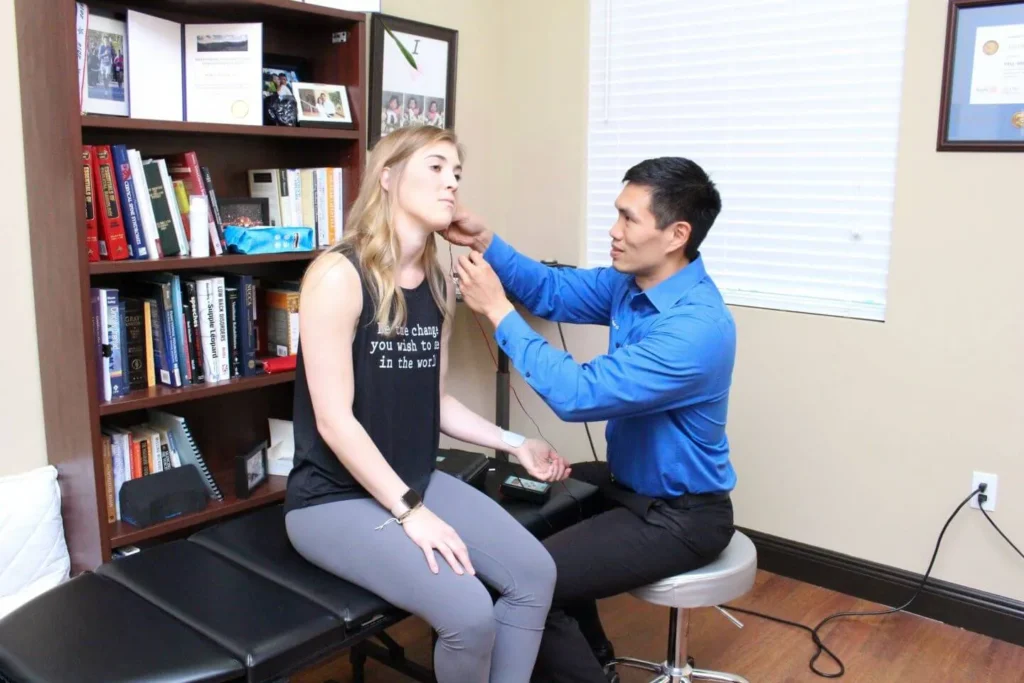
So how can a chiropractic intervention possibly improve a patient with Parkinson’s? Based on conventional theories on Parkinson’s, the substantia nigra and the dopamine producing neurons in this part of the brain has to be the target for treatment and therapy. As much as I love chiropractic as a profession, there’s nothing that I am doing that is going to magically make substantia nigra neurons grow back to life again.
One of the intriguing things that brought me from a traditional form of chiropractic to an upper cervical and neurological approach was the way that this form of chiropractic seemed to produce good results with people who had neurodegenerative disease like Parkinson’s Disease. Getting the chance to help people gain some aspects of their quality of life when conventional medicine just didn’t provide much was something I’ve always appreciated about chiropractic.
I was drawn to a study by an Upper Cervical Chiropractor named Erin Elster who wrote up case studies on dozens of patients with PD. The study looked at 81 patients with PD or multiple sclerosis and monitored the patient response to upper cervical care over time. In the Parkinson’s group, there were 37 patients and 23 out of the 37 patients experienced an improvement in at least half their symptoms. These symptoms ranged from musculoskeletal symptoms like posture and pain to more neurologic problems like tremor and balance. Out of those 23 patients, 16 of them experienced a substantial improvement where all of their symptoms showed either improvement or resolution.
Back in 2011, I documented some similar improvements in a 67-year-old female patient with Parkinson’s Disease who was having problems with repetitive falls and tremors that was causing difficulty with basic activities of life and work. Within 6 months, the number of falls reduced significantly while tremor and rigidity were noticeably improved. You can read about my early thoughts on this in the original case study here.
I’ve had the pleasure of seeing several patients with Parkinson’s Disease get pretty similar results over the years with one even having a 70% reduction in tremor activity and improved gut symptoms.
If we aren’t affecting the damaged substantia nigra, then how is a chiropractic intervention providing improvements in PD symptoms? One idea is that chiropractic adjustments may help drive better compensation in movement planning by the way that adjustments can increase activity of the cerebellum. This way, if the basal ganglia can’t control your movements, then the cerebellum can help make up for it a little bit.
There’s also a theory of neurodegeneration that involves changes in cerebral spinal fluid and venous drainage that applies well to multiple sclerosis, but no evidence currently exists that a mechanism like this would create parkinsonism.
But the thing I’m most interested in is that gut-brain connection we discussed earlier.
The vagus nerve and it’s connection between the brain and gut is growing area of interest for a small subset of chiropractors. We know that we can use heart rate variability (HRV) as a way to measure the activity of the vagus nerve and we know that chiropractic has some preliminary studies showing it has a positive impact on HRV.
The craniocervical junction is particularly unique because of it’s proximity to the the brain stem and key neurovascular structures that may influence the vagus nerve. Strains, fixations, misalignments, and malformations of the skull and neck can impact the way the brain processes important neurological information and indirectly impact the home of the vagus nerve in the brainstem.
Additionally, top bone in the neck called the Atlas also has a capacity in some patients to compress the internal jugular vein which has the capacity to wreak havoc on the vagus nerve by causing a condition called dysautonomia. Studies have shown that severe forms of dysautonomia do produce Parkinsonism via multiple system atrophy, and some PD populations can show characteristic signs of dysautonomia.
While all of these is very much hypothetical, if we know we are impacting HRV, then it is plausible that every time we touch the upper neck, we are potentially affecting the vagus nerve and those very important bacteria in our guts.
Closing Thoughts
But I won’t say that results with Parkinson’s Disease are typical. I’ve taken care of some patients with PD who get no improvement at all. A lot of this depends on the nature of the person’s illness, how far along in the disease process the patient is, and other factors that can dictate the brain’s ability to adapt. It’s a progressive and challenging illness no matter how you spin it.
However, Parkinson’s Disease is an illness that can have devastating effects on someone’s quality of life as they age. At best we are decades away from a meaningful cure, and in the meantime we need to explore safe options that can meaningfully improve someone’s quality of life for all too fleeting moments that their brains are mostly in tact.